[THOUGHTS ON STORIES] Who’s the Protagonist (II) – Focusing on the Big Guy

[The header image was AI generated. I only wish I could draw that good.]

A couple of years back (more or less) I wrote a little on Protagonists. As a refresher, here are the terms as I see them as a Writer, Critic, and in general mad man:

  • Plot: A series of Action/Reaction events that form a story.
  • Protagonist: Character who’s choice has the greatest effect on the Plot.
  • Antagonist: Character that either opposes the Protagonist or is opposed by the protagonist. A proper Antagonist has a greater effect on the Plot than most.
  • Hero: The moral center of the Plot. They might not be the Protagonist, as that role isn’t a moral choice.
  • Villain: No shock, but a character that is the opposite of the Hero. Someone actively doing harm. They can even be the protagonist, as that role isn’t a moral choice.
  • Unfortunate Soul: Character who endangered by the Plot’s events that for reasons can’t do anything. They are never a Protagonist or an Antagonist, as they’re choices have little to no effect on the Plot.

Let’s add one final term, just for fun:

  • Force: An element that can drive the Plot that doesn’t have the agency of a Protagonist or Antagonist. It makes no conscious choice for or against, but actively effects the Plot.

That’s seems like a fine sampling.

Let’s look at a few stories, see how this shakes out. As I am who I am, we are looking at the three Godzilla movies that share the name Godzilla. Starting with the 1998 classic Godzilla.

Don’t make that face. It’s unbecoming.

Spoilers, for what it’s worth.
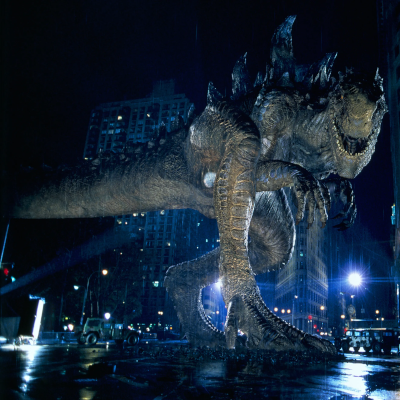

The Protagonist in Godzilla 98 is Nick Tatopoulos. He’s the one who makes all the choices that matter. He wants to stop Godzilla from causing destruction.

Opposing him as the Antagonist is, of course, Godzilla. All Godzilla wants is to roam about and be the best little monster it can be. Towards the end, with its offspring slaughtered, it actively tries to harm Nick. The size of its choices matter.

Ahem.


With Godzilla 14, things get interesting.

The Protagonists in this story are the bug like Muto. Everyone reacts to their choices. It doesn’t matter how they’re destructive. Being the Protagonist isn’t a moral choice, and every choice they make moves the Plot forward.

That said, once again the Antagonist here is Godzilla. He doesn’t want the Mutos to get what they want. They threaten his existence and until they stop, he won’t stop, either.

Now where does the human character, Brody, stand here? He’s the Hero. His actions, while important, don’t change the basic conflict between Muto and Godzilla. He helps Godzilla deal with the situation, unquestionably. But when everything is said and done, he does nothing that changes the Plot. If he wasn’t involved, the conflict would have continued and ended just fine without him.

Albeit perhaps not as happily for the world.


Now if you thought that last bit was wrong headed… well you ain’t heard nothing yet.

The Protagonist in the original Godzilla is the character you see the least: Daisuke Serizawa. Standing against him is the Antagonist… Hideto Ogata.

Yeah. That’s right. Godzilla doesn’t matter in his own first movie. at best he’s a Force.

Isn’t that wild? But hear me out.

What Godzilla is is unimportant. He doesn’t have to be a radioactive dinosaur. He could be anything from a giant octopus (which he almost was) to radioactive sludge.

What matters is that he’s a problem that needs solved.

Serizawa has the solution to that problem. It is his choice that matters the most in the movie. To refrain from acting means the threat continues unhampered. Acting, on the other hand, might unleash a far worse threat. In fact, Serizawa is pretty certain that it will.

Ogata, however, opposes this. He sees only the threat before them and forces Serizawa into a decision. And, in my humble opinion, that decision is the worst possible choice.

To reinforce this, remember there is only one scene between Serizawa and Godzilla. Godzilla, at the time, is minding his own business. His threat, while real and present, is also theoretical at that point.

As I’m throwing cod theory about, let me say that the real antagonist should have been Emiko Yamane. Ultimately she’s the one who betrays Serizawa on so many levels. But that’s expecting a little much from a film out of the Fifties.


Now that was fun. Might go back to this little thought experiment at another time.
[THOUGHTS ON STORIES] Exploring Nero Wolfe Mysteries: A Deep Dive

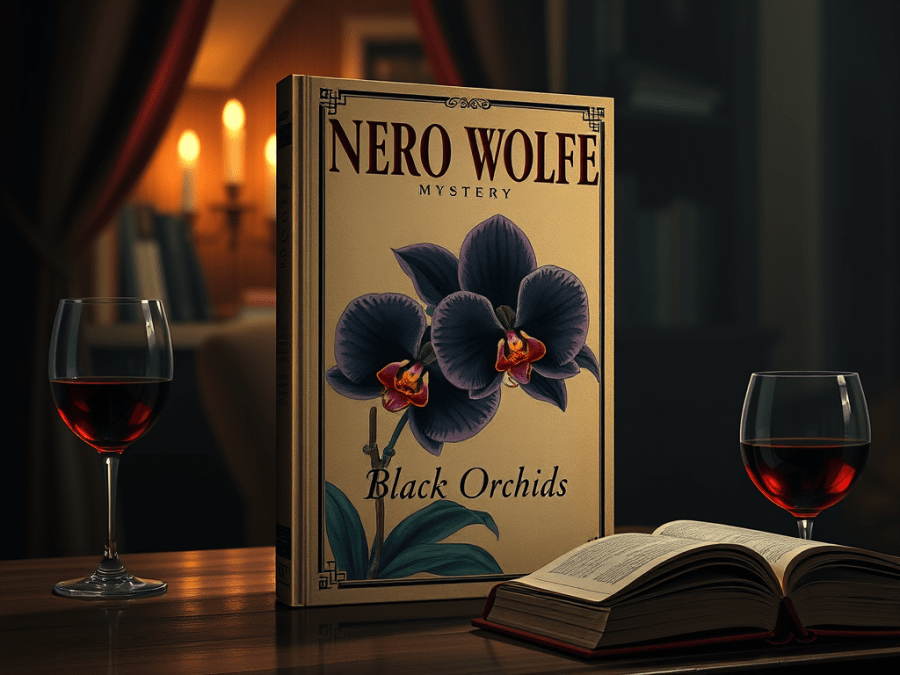
There’s very little better than a Nero Wolfe mystery. They’re just something else. I’m reading Black Orchids right now. The only reason Wolfe is getting involved in the murder is so he can lay hands on the titular flower. That guy is so self centered, it’s hilarious. Book’s been fun so far, too.

[Sorry about the misleading title. Out of curiosity I asked WordPress’s AI to come up with one and this was its choice. With the post being only a paragraph at the time, how could I resist? The post header’s AI too, for the record.]

[THOUGHTS ON STORIES] Who is the Protagonist? (I)

The mechanics of a story is only interesting to writers and critics. As I am both, off and on, I tend to think about such things. Thus the readers of this site can benefit from the ravings of an unsound mind.

I did say I was a writer AND a critic, remember.

While thinking about the matter, I came up with some interesting thoughts on classic Genre films. So in order to process this, I thought I’d write up an essay and set some terms. This might drift over to the Sister Site at some point, as it might be germane to the proceedings. It’s also going to be long, so I’m stretching it out a few days.

Let’s start with the basics. Things most writers and critics can get behind.

First off, most Stories, be it in film, on stage, or in a book, have this thing called a Plot. In the simplest terms, the Plot is Action/Reaction. An Action happens and there is a Reaction to it. It is motion, it is movement.

The Story’s Protagonist is the character whose Actions/Reactions matter the most. It is his (hers, its, whatever’s) who makes the choice or choices that matters most.

In Star Wars: A New Hope, Luke Skywalker is the Protagonist. It’s his decision to help Obi-wan Kenobi that affects every other decision down the length. Everything hinges on that one choice.

In Beast from Twenty Thousand Fathoms, Thomas Nesbitt is the Protagonist. His efforts to warn the world about the Beast, the Rhedosaurus, brings end characters that wouldn’t have been involved otherwise and, in the end, it’s his experience with radiation that solves the final problem. His choices mattered.

Stories that don’t have a Protagonist are possible, but examples don’t leap to mind. Keep in mind it’s not the length of “screen time” that determines who the Protagonist is. It’s the Weight of the Choice that as a rule matters.

I’ll get back to Weight of Choice in a second.

Opposing the protagonist is the Antagonist. This character either Acting (doing something the Protagonist opposes) or Reacting (opposes something the Protagonist wants). With this character, too, the Weight of the Choice defines him (her, it, whatever). The Character whose choices give the Protagonist the most problems is often the Antagonist.

To go backwards, in Beast from Twenty Thousand Fathoms, it is the Rhedosaurus who is the Antagonist. It wants to stomp around the place and eat passing people. Nesbitt opposes this, first by warning people of the existence of the Rhedosaurus, then by confrontation.

In Star Wars: A New Hope, the Antagonist is Grand Moff Tarkin. Oh, yeah, Tarkin. He’s the one calling the shots. He leads the tropes, makes the decision to destroy random planets, and so on and so fort. Darth Vader, as impressive as he is, is but a lackey.

Now the terms Protagonist and Antagonist are not moral terms. While the Protagonist is often a Heroic figure, that is not what defines him. Same is true with the Antagonist. Both of them can be Good People; both of them can be Bad People. It’s really not relevant.

What is relevant is the Weight of Choice. How does the choice affect the Plot? How does the choice affect the one making it? The bigger the change, the more weight it has.

In both my examples, the choices made by the protagonists alter the course of the Plot. They save people, they get people killed, they are harmed by their actions and their actions harm others. If they weren’t in the Story everything would change. It would not be the same story.

To give another example, look at the Mystery TV series Columbo. The title character, Lieutenant Columbo, is not the Protagonist. That would be the murderer of the episode. It is their choices that make the plot run. Were they not there, nothing would happen. Columbo, the Antagonist, is there to stop them. His choices have Weight, but not as much as those he opposes.

Were we to put things in a more moral fashion, we would use terms like Hero and Villain. In fact, I’m going to use them as actual Character Types like Protagonist and Antagonist.

The Hero is the moral force in the story, the one’s whose attitudes the Reader is probably supposed to emulate. He (She, It, Whatever) might not do the right thing all the time, but by and large his actions are what one would consider Moral and Good.

The Villain is the opposite number. He (etc, etc) is in it for himself, his actions are selfish and more often than not Evil.

I’m in a mood. I’m adding a third Character Type: The Unfortunate Soul. Unlike the Protagonist and Antagonist, the Unfortunate Soul has very little agency. While they can act, they need help. They can’t do it on their own. Their choices have the least Weight of them all.

To give examples, let’s look at the detective series involving Sherlock Holmes.

Holmes is the series Protagonist. His decisions shape the course of the plot. His clients are Unfortunate Souls who can’t resolve their own dilemmas. For them Holmes risks all, whether just his reputation as a detective or, on occasion, his very life.

The people Holmes goes after are, more often than not, are Villains. They want something they shouldn’t have. You could argue that Holmes’ opposition to them makes them Antagonists, too. However not only they don’t often have the same Weight of Choice your common Antagonists have, they don’t often have conflict with the Protagonist beyond a basic level.

For instance, the killer in The Hound of the Baskervilles actively tries to get around Holmes to accomplish one more murder. With A Scandal in Bohemia, Holmes is pitted against Irene Adler in acquiring certain pictures; it is a definite struggle between two wills. The Final Problem and its sequel, The Adventure of the Empty House have the main threat be killers after Holmes. Each present conflict for Holmes and are in fact Antagonist.

Oh, and Doctor Watson? He’s the Hero, not Holmes, despite the detective’s virtuous efforts. He tends to be the moral center of Holmes’ world.

Simple. There are always going to be exceptions to the rule for these terms, and with the possible exception of the Protagonist not all are needed for a Story. That’s the nature of the beast.

Next time, we’ll look at more individual stories and see who is the protagonist and who is not.

[LOVECRAFT] Dagon

Spoilers for a short story that is over a hundred years old. Why haven’t you read it yet? It’s free on the internet!

Dagon is one of the first stories H. P. Lovecraft wrote as an adult. It is both typical and atypical of his Horror work. Typical in that its protagonist goes where he shouldn’t and is driven to suicidal madness. Atypical because the protagonist is he really doesn’t deserve his fate, as he doesn’t seek out what he finds.

Quick summary:

It’s World War I and the Germans have captured the main character’s boat. Not wanting to be a prisoner of war he escapes in a life boat. After floating aimlessly for some time an underseas eruption hurls what passes for an island up from the ocean floor. This imprisons his boat, forcing him to explore his environment. In this exploration he not only discovers that there are titanic fish people in the world but also get to see one up close. His escape from the situation leaves him mad, and, believing himself pursued by the fish man, writes his tale down before the fish man comes for him and he’s forced to kill himself.

All of this, is told in the first person from our protagonist’s perspective. There is a very slight chance we can interpret the whole thing as the ravings of a mad man. The ending helps in this regard, as it’s hard to believe that a desperate man would keep writing as a titanic fish person fumbles open his apartment door.

Outside of the ending and the reoccurring problem that Lovecraft thinks his readers are as well read as he is, the story is pretty good. I’ve seen it compared a lot to Call of Cthulhu, but in fairness it’s not trying to lift the same weights Call is going for. It does it’s job. It may not be one of his bests, but it sure isn’t one of his worst. Especially worth considering is how early it is in his career.

Not a favorite, but I reread it now and then.

[THOUGHTS] Jokes Just For You

When trying to be funny, on line or in the really real world, you have to remember one thing: Some jokes are just funny to you.

Of course this holds true with a lot of things. Like Horror for instance. Some people are scared of spiders, some aren’t. Some are willing to believe in ghosts for a span, some won’t. You can’t make people feel the terror, you can only try.

Thing is, with Horror, there’s always going to be the other option. That it’s funny when it should be scary. That happens. You might not want it to happen, but it does happen.

Humor doesn’t have that fall back.

Bad humor kills. It even angers.

I have seen many a Comedies I didn’t get. Like Napoleon Dynamite. Well, fair’s fair, I haven’t watched the film, so I’m not speaking out of experience. But what little I’ve seen doesn’t encourage me to see more. I know people who love the film. Maybe I’m missing out.

I don’t think so.

Of late, though, more and more Comedies have been leaving me… irritated.

Family Guy, for instance. Once upon a time, I could watch full episodes of the series and enjoy it. Over time, however, I’ve gotten to the point where if every single main character in the show died of cancer, on fire, covered with bees, with sharp things jabbing under their fingernails I could get behind it. If there are decent characters on the show, they’re few and far between.

Thus I don’t watch the show.

But. I can still see how some people might like it.

I’ve watched small bits of certain episodes and said, “Hey! That’s funny. Be funnier if they all exploded in a ball of green flame, GREEN FLAME! Still, ha ha.”

I understand Family Guy‘s exisitance.

I don’t understand Velma‘s existence. At all.

This is a brand new cartoon that came out this year. Allegedly the “true story” behind the classic Scooby Doo series. Only everybody, and I mean EVERYBODY is to one degree or another a hateful, soul crushing monster.

Again, in fairness, I’ve not sat through a full episode. There may be some bon mot or sight gag I haven’t seen that’s simply hilarious.

What I have seen from clips makes me doubt it.

The main character, Velma, is Evil with a capital E. She is a narcissist who hurts everyone around her. The viewer’s supposed to root for her. Laugh at her antics, nod at every truth bomb she lays out, whether it’s a jab at white people or a stab at men, or whatever is the focus of her ire at the moment. And there seems to be a hell of a lot of ire.

None of these people are even remotely like the characters they’re stealing from.

Remember what I wished on the characters of Family Guy? Well that’s too good for the characters of Velma. They need to be…

Excuse me for a second.

Here it is.

“Hanging’s too good for ’em. Burning’s too good for ’em! They should be torn into little bitsy pieces and buried alive!”

Heavy Metal. Kinda

I’ll bet that the writers simply loved every word they wrote. Thought they had a modern classic on their hands. Trouble is that they were writing stuff only they found funny. And it shows. On Rotten Tomato Velma has a below 50% score with the critics, and around 6% with regular people.

That’s an epic failure right there.

[Poe] Some Musings Over a Container of Sherry

Spoilers for a short story published very nearly two hundred years ago.

When you are good at what you do, people talk about you. Edgar Allan Poe was very, very good. He even survived a character assassination early one. The man was a beast. And thus people talk.

Among his tales of cats and mad men there is one tale that stands above the rest: The Cask of Amontillado. In short, it’s a tale of revenge that still packs a wallop even even after over a century. The narrator, Montresor, lures back his prey, Fortunato, to a fate worse than mere murder. Bleak, dark, and not quite like anything else Poe ever wrote.

Now, again, when you’re good, people talk, and this story gets a lot of talk. Many make of the fact that Montresor never says why he does what he does, suggesting that he himself might be mad.

The thing is, this supposition isn’t supported in the narrative.

Before talking about this, one crucial fact must needs pointing out.. Consider the first paragraph of the story:

The thousand injuries of Fortunato I had borne as I best could, but when he ventured upon insult I vowed revenge. You, who so well know the nature of my soul, will not suppose, however, that I gave utterance to a threat. At length I would be avenged; this was a point definitively settled — but the very definitiveness with which it was resolved precluded the idea of risk. I must not only punish but punish with impunity. A wrong is unredressed when retribution overtakes its redresser. It is equally unredressed when the avenger fails to make himself felt as such to him who has done the wrong.

The Cask of Amontillado
Edgar Allan Poe

The Cask of Amontillado doesn’t have only two characters. Unlike The Black Cat and The Tell Tale Heart, the narrator isn’t speaking into the void to whoever will listen. Montresor is speaking to a very definite person. He has a very definite audience in mind. This person who knows so well the nature of Montresor’s soul.

Who is this person? As with so much of the story, it doesn’t matter. It could be a friend, a brother, a wife, a lover. Not important. What matters is this person’s existence in the story.

For simplification let’s call this person Grim.

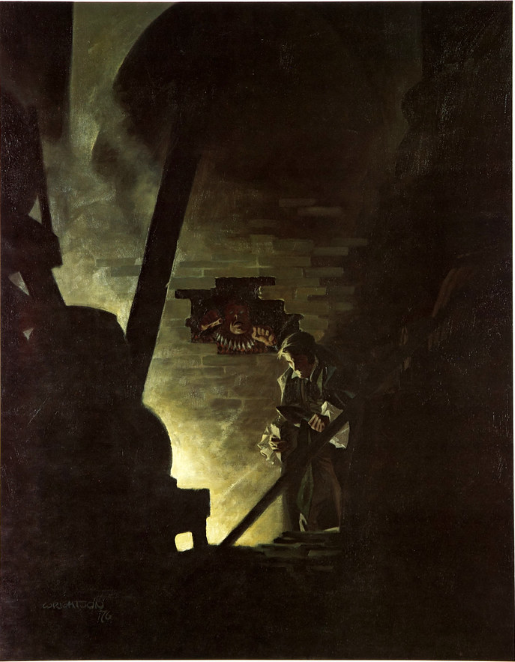
The Cask of Amontillado
Bernie Wrightson

Poe’s big thing was precision. Every little bit plays on every other bit until he hits the mark he needs to hit. Which he was very good at doing.

Montresor never once expounds upon why he kills Fortunato to Grim. He expects Grim to know and understand at once. That is because he tells Grim exactly why he kills Fortunato.

Fortunato insulted him.

That’s it.

No great mystery to solve there. It could have been anything. Duels were more common back then, and they didn’t need that much of a reason for happening. Insults were the primary cause.

Fortunato’s reaction to his fate also points the way. Appaled by the act as he is, he never once asks the important question of why it’s happening to him.

That’s because he knows why.

Fortunato thought himself safe when his insult passed without action. Another factor is that, as Montresor tells Grim, Fortunato was “a man to be respected and even feared.” Someone that believed himself above reprisals.

Thus it’s very likely Montresor isn’t one of Poe’s mad men. He’s merely a very clever, very evil man.

Maybe that’s why, unlike with most Poe’s killers, Montersor gets away with it in the end.